


Product Description
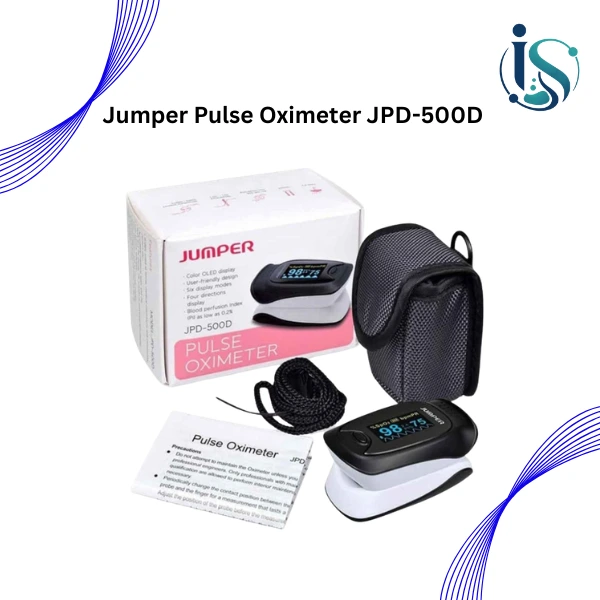
The Jumper Pulse Oximeter JPD-500D is a compact fingertip monitoring device designed to measure blood oxygen saturation (SpO₂), pulse rate (PR) and perfusion index (PI) through the finger.
JUMPER officially describes the JPD-500D as an OLED fingertip pulse oximeter using photoelectric oxyhemoglobin inspection technology together with pulse-scanning technology to measure oxygen saturation and pulse rate.
The device provides three useful parameters:
- SpO₂
- Pulse Rate
- Perfusion Index
These readings are presented on a clear OLED display.
The manufacturer’s specification lists an SpO₂ accuracy of ±2% within the 70–100% range and a pulse-rate range of 25–250 BPM with ±2 BPM accuracy.
The JPD-500D also includes features such as:
- Multiple display modes
- Adjustable display brightness
- Alert / value-limit reminder function
- Plethysmograph display
- Perfusion Index display
- Real-time battery-status indication
JUMPER specifically promotes these functions on the current JPD-500D product page.
With compact dimensions of only 62.2 × 37 × 33.1 mm, the pulse oximeter is easy to keep at home, carry during travel or store with appropriate healthcare equipment. It operates using two AAA batteries, eliminating the need for mains electricity during measurement.
JUMPER identifies the intended application range of this particular model as adult and adolescent.
The manufacturer describes applications including family care, hospitals, community healthcare and physical-care monitoring associated with sports. JUMPER also recommends performing measurements while the user is in a calm state.
A pulse oximeter is useful for estimating oxygen saturation and monitoring trends, but the reading should not be treated as a standalone medical diagnosis.
FDA guidance emphasizes that oxygen-saturation readings should be considered together with symptoms and other relevant information because pulse oximeters can produce inaccurate readings under some circumstances.
Key Features
- Genuine JUMPER model JPD-500D.
- Fingertip pulse oximeter.
- OLED display.
- Measures SpO₂.
- Measures pulse rate.
- Measures Perfusion Index (PI).
- Plethysmograph waveform display.
- SpO₂ specified range/accuracy: 70–100%, ±2%.
- Pulse-rate range: 25–250 BPM.
- Pulse-rate accuracy: ±2 BPM.
- Multiple display modes.
- Multi-direction viewing.
- Adjustable brightness.
- Value-limit reminder function.
- Real-time battery-status display.
- Compact fingertip design.
- Dimensions: 62.2 × 37 × 33.1 mm.
- Powered by two AAA batteries.
- Suitable for adults.
- Suitable for adolescents.
- Easy one-device fingertip measurement.
- Portable for appropriate home and professional use.
- Suitable for monitoring before or after sports activity where appropriate.
- Manufacturer recommends measurement in a calm state.
The main performance specifications and features above are published by JUMPER on its official JPD-500D product page and current product catalogue.
Product Overview
SpO₂ Measurement
SpO₂ represents the pulse oximeter’s estimate of peripheral oxygen saturation.
The JPD-500D measures this parameter through the finger using optical technology.
JUMPER specifies:
SpO₂ Range / Accuracy Specification: 70–100%, ±2%
A pulse oximeter does not directly replace arterial blood-gas testing.
FDA explains that pulse oximeters provide an estimate of blood oxygen saturation and that readings can be affected by several physiological and environmental factors.
Pulse Rate Measurement
In addition to oxygen saturation, the JPD-500D displays pulse rate.
The official manufacturer specification states:
Pulse Rate Range: 25–250 BPM
Accuracy: ±2 BPM
This allows the device to display pulse information at the same time as the oxygen-saturation measurement.
The reading remains an instrument measurement and should be interpreted according to the user’s circumstances and appropriate healthcare guidance.

Perfusion Index – PI
The JPD-500D includes Perfusion Index (PI) as one of its displayed parameters.
JUMPER officially lists:
Parameters: PR / SpO₂ / PI
PI is related to the pulse signal detected at the measurement site and can provide useful information about the strength of the detected peripheral pulse signal.
It should not be interpreted as a standalone diagnosis.
OLED Display
The JPD-500D uses an OLED display.
The OLED screen provides clear presentation of:
- SpO₂
- Pulse rate
- PI
- Pulse waveform / plethysmograph
- Battery status
- Other available measurement indicators
JUMPER also identifies adjustable brightness and multiple display modes as features of the JPD-500D.
Multiple Display Directions
JUMPER’s current catalogue identifies the JPD-500D with a multi-direction display configuration, allowing measurement information to be viewed conveniently from different orientations.
This can make the screen easier to read either by the person wearing the device or by another person assisting with measurement.
Plethysmograph Waveform
The manufacturer lists Plethysmograph & PI among the JPD-500D display features.
The waveform provides a visual representation of the detected pulse signal.
Users should still wait for a stable reading and follow the manufacturer’s instructions instead of interpreting an unstable display as a final result.
Adjustable Brightness
Screen brightness can be adjusted according to viewing conditions.
JUMPER specifically lists Brightness Adjustable among the JPD-500D features.
This can improve visibility under different indoor-lighting conditions.
Value-Limit Reminder
JUMPER’s official specification lists a Value Limited Remind function for the JPD-500D.
This function should not be confused with a medical diagnosis.
The user should follow the current manual and professional medical advice when interpreting readings or alerts.
Real-Time Battery Status
The device provides real-time battery-status information according to JUMPER’s specification.
This helps users identify when the batteries may require replacement.
Two AAA Battery Operation
The JPD-500D operates using:
2 × AAA batteries.
Battery operation makes the device:
- Portable
- Independent of mains electricity during measurement
- Convenient for appropriate travel use
- Easy to store as part of home healthcare equipment
Use the correct battery polarity according to the current user manual.
Main Applications
Home Monitoring
JUMPER identifies family or home care among the application environments for its fingertip pulse oximeter.
The JPD-500D can provide SpO₂ and pulse-rate measurements for adults and adolescents when used correctly.
Home users should remember that a pulse oximeter is only one source of information.
FDA advises considering both the reading and symptoms, because a person may have low oxygen levels without showing every expected symptom and a pulse oximeter can occasionally provide inaccurate measurements.
Hospital and Healthcare Environment
JUMPER includes hospitals among the environments where this pulse-oximeter technology may be used.
For institutional use, the facility should verify:
- Regulatory status
- Accuracy requirements
- Approved intended use
- Cleaning procedures
- Infection-control requirements
- Required documentation
before procurement.
Community Healthcare
The manufacturer’s current product description also identifies community healthcare as an application environment.
Its small battery-powered design makes the device convenient where compact monitoring equipment is desirable.
Adult Monitoring
JUMPER officially specifies the JPD-500D application range as Adult / Adolescent.
This should be used instead of making unsupported claims that the model is suitable for infants or neonatal patients.
Adolescent Monitoring
Adolescents are also included in the manufacturer’s official application range.
Correct finger positioning and measurement conditions remain important for obtaining a stable result.
Sports-Related Monitoring
JUMPER describes the device as suitable for physical-care monitoring associated with sports and notes that it may be used before or after exercise. The manufacturer recommends performing measurements while the person is in a calm state.
It should not be used as a substitute for professional assessment when symptoms or medical concerns are present.
Travel and Portable Use
Because the JPD-500D measures only 62.2 × 37 × 33.1 mm and operates on two AAA batteries, it is practical to carry as compact personal monitoring equipment.
Appropriate storage and environmental conditions should follow the user manual.
Key Benefits
- Three parameters: Displays SpO₂, pulse rate and PI.
- OLED display: Provides clear digital measurement information.
- Pulse waveform: Plethysmograph helps display the detected pulse signal.
- Adjustable brightness: Allows screen brightness adjustment.
- Multiple display modes: Convenient viewing options.
- Multi-direction viewing: Easier reading from different positions.
- Compact size: Only 62.2 × 37 × 33.1 mm.
- Battery powered: Uses two commonly available AAA batteries.
- Portable: Suitable for appropriate home or travel monitoring.
- Adult/adolescent application: Manufacturer-defined intended user range.
- Real-time battery indication: Helps identify battery condition.
- Value-limit reminder: Provides a reminder function according to manufacturer specifications.
- Simple fingertip measurement: Requires no external probe for standard fingertip use.
- No mains power needed: Measurements can be performed away from a wall outlet.
- Established manufacturer: Produced by Shenzhen Jumper Medical Equipment Co., Ltd.
The feature set and dimensional specifications are based on JUMPER’s current official product information.
Who Should Buy This Product?
The Jumper Pulse Oximeter JPD-500D may be suitable for:
- Adult home users
- Adolescents under appropriate supervision
- Families requiring a fingertip pulse oximeter
- Clinics
- Hospitals, subject to institutional approval
- Community healthcare facilities
- Medical training facilities
- Healthcare professionals
- Nurses
- Caregivers
- Medical students
- Nursing students
- Health-science institutions
- Diagnostic and healthcare facilities where appropriate
- Sports-related users seeking appropriate SpO₂ and pulse monitoring
- Institutional procurement teams
- Medical-equipment suppliers
- Healthcare product retailers
Institutional buyers should confirm all required medical-device and regulatory documentation before procurement.
Usage and Handling Summary
Sit or remain calm before taking the measurement.
JUMPER recommends measurements in a calm state, including when the device is used before or after exercise.
Insert the finger fully into the measuring chamber.
Keep the fingernail surface facing upward according to the JPD-500D user instructions.
Press the power button to start the device.
Remain as still as possible while the oximeter measures.
Wait for the displayed values to stabilize.
Observe:
- SpO₂
- Pulse Rate
- PI
- Pulse waveform
where shown.
Avoid unnecessary finger movement during measurement.
If the reading appears unusual:
- Remain calm.
- Make sure the finger is positioned properly.
- Confirm that the hand and finger are sufficiently warm.
- Minimize movement.
- Repeat the measurement after allowing the reading to stabilize.
- Consider symptoms and healthcare instructions rather than relying on one number alone.
FDA advises users to record readings when appropriate and pay attention to changes over time, while also considering how they feel.
Factors That May Affect Pulse Oximeter Accuracy
Pulse oximetry is useful, but no fingertip oximeter should be presented as perfectly accurate under all conditions.
FDA currently identifies several factors that can affect pulse-oximeter readings, including:
- Poor circulation
- Skin pigmentation
- Skin thickness
- Skin temperature
- Current tobacco use
- Fingernail polish
FDA’s technical review additionally discusses factors such as motion, low perfusion and other physiological variables that may influence pulse-oximeter performance.
For a more reliable measurement:
- Keep the hand still.
- Follow the manufacturer’s finger-placement instructions.
- Avoid measuring immediately after excessive movement.
- Ensure the finger is not unusually cold where possible.
- Consider removing nail polish if readings appear unreliable.
- Wait for the value to stabilize.
- Compare repeated readings rather than making an important decision from an obviously unstable display.
Understanding Pulse Oximeter Readings
The JPD-500D provides an estimate of oxygen saturation, not a laboratory measurement of arterial oxygen content.
FDA advises that pulse-oximeter readings should be interpreted together with signs and symptoms rather than used alone to diagnose a condition such as hypoxia.
Symptoms that may warrant medical attention can include breathing difficulty, worsening shortness of breath, chest discomfort or bluish coloration around the face, lips or nails. FDA notes that not everyone with low oxygen will necessarily show all of these symptoms.
Users with a medical condition should follow the target ranges and action plan given by their healthcare professional rather than relying on a generic internet threshold.
Cleaning and Care Summary
Switch off or remove the device from the finger before cleaning.
Follow the current JUMPER user manual for cleaning and disinfection.
Do not immerse the electronic unit in water or other liquids.
Do not pour or spray liquid directly inside the sensor chamber unless explicitly permitted by the manufacturer.
Use only compatible cleaning materials.
Allow the device to dry appropriately before reuse.
Keep the optical sensor area clean.
Store the pulse oximeter:
- In a clean location
- Away from excessive moisture
- Away from excessive heat
- Protected from impact
- Away from corrosive materials
If the device will not be used for an extended period, follow the battery-storage instructions in the current manual.
Battery Replacement
The JPD-500D uses:
2 × AAA batteries.
When battery power is low:
- Open the battery compartment.
- Remove the old batteries.
- Install two appropriate AAA batteries.
- Match the correct positive and negative polarity.
- Close the battery compartment securely.
- Confirm that the unit powers on normally.
The available JPD-500D user guide instructs users to replace batteries when the low-power icon appears and stresses correct polarity during installation.
Safety Considerations
- Use the device according to the current JUMPER user manual.
- Do not use one reading as a standalone medical diagnosis.
- Consider symptoms as well as SpO₂ readings.
- Seek appropriate medical evaluation when symptoms are concerning.
- Remember that pulse oximeters can produce inaccurate readings.
- Keep the finger still during measurement.
- Be aware that nail polish can affect readings.
- Be aware that poor circulation can affect accuracy.
- Skin temperature can affect accuracy.
- Skin pigmentation can affect pulse-oximeter performance.
- Do not immerse the electronic device in liquid.
- Do not use a visibly damaged unit.
- Do not use damaged or leaking batteries.
- Install batteries with correct polarity.
- Keep the device appropriately clean between users.
- Follow institutional infection-control procedures when shared.
- Do not automatically assume suitability for infants or neonates; JUMPER currently specifies the JPD-500D for adults/adolescents.
- Do not claim that PI, SpO₂ or pulse rate independently diagnoses a medical condition.
- Confirm required regulatory documentation before clinical or institutional use.
FDA specifically warns that pulse oximeters have limitations and that readings can be inaccurate under certain circumstances.
Limitations and Important Considerations
- Pulse oximetry provides an estimated SpO₂ value.
- It does not replace arterial blood-gas analysis where that testing is clinically required.
- Measurement accuracy can be influenced by patient and environmental factors.
- Poor peripheral circulation may reduce reading reliability.
- Motion may interfere with measurement.
- Nail polish may influence accuracy.
- Skin pigmentation may influence pulse-oximeter performance.
- Cold fingers or skin-temperature differences may affect readings.
- A single measurement should not be used to self-diagnose illness.
- The manufacturer lists the JPD-500D application range as adult/adolescent.
- Pediatric, infant or neonatal suitability should not be claimed without model-specific documentation.
- Exact regulatory certification of the supplied Inaya Scientific batch should be verified.
- FDA approval/clearance should not be claimed without documentation for the exact marketed device.
- Included batteries should be confirmed from current packaging.
- Included lanyard or other accessories should be confirmed from the supplied box.
- Warranty conditions can vary by seller.
- Product packaging can change between batches.
- Clinical decisions should be made by an appropriate healthcare professional using the complete clinical picture.
FDA’s March 2025 consumer guidance specifically emphasizes the limitations of pulse oximetry and recommends considering readings in the context of symptoms and other information.
Available Pack Size or Variations
The requested configuration is:
Brand: JUMPER
Product: Fingertip Pulse Oximeter
Model: JPD-500D
Display: OLED
Parameters: PR / SpO₂ / PI
Application Range: Adult / Adolescent
Dimensions: 62.2 × 37 × 33.1 mm
Power: 2 × AAA Batteries
SpO₂ Specification: 70–100%, ±2%
Pulse Rate: 25–250 BPM, ±2 BPM
Pack Size: 1 Unit
These core specifications are provided by JUMPER’s official product information.
JUMPER manufactures additional fingertip pulse-oximeter models, including JPD-500A, JPD-500C, JPD-500E, JPD-500G and other configurations. Features such as screen type, PI, display modes and dimensions differ by model, so specifications should not be mixed between JPD-series products.
Jumper JPD-500D Pulse Oximeter Price in Bangladesh
The latest Jumper JPD-500D Pulse Oximeter price in Bangladesh should be confirmed directly from Inaya Scientific at the time of ordering.
For current Bangladesh market reference checked on 14 August 2026, Arogga lists the JPD-500D OLED version at ৳1,600.
BDStall currently shows offers for the JPD-500D in approximately the ৳1,350–৳1,900 range, depending on seller and warranty conditions.
These third-party prices should not be treated as Inaya Scientific’s selling price.
The final price may vary according to:
- Current stock
- Supplier price
- Warranty
- Product batch
- Included accessories
- Import cost
- Exchange rate
- Order quantity
- Institutional quotation requirements
- Delivery location
For an accurate quotation, request:
Jumper Fingertip Pulse Oximeter – JPD-500D – OLED – 1 Unit
Availability and Delivery in Bangladesh
The Jumper Pulse Oximeter JPD-500D can be supplied by Inaya Scientific subject to current stock and product confirmation.
For institutional or bulk orders, customers should provide:
- Required quantity
- Institution or organization name
- Required model: JPD-500D
- Warranty requirement
- Certification or regulatory-document requirement
- Delivery location
Before accepting a bulk delivery, buyers should ideally verify:
- JUMPER branding
- JPD-500D model number
- OLED display
- SpO₂ / PR / PI functionality
- Physical condition
- Serial information
- Packaging condition
- User manual
- Battery requirement
- Warranty information
- Manufacturing / batch information where applicable
- Required regulatory documentation
- Current price
Why Buy From Inaya Scientific?
- Current Bangladesh price confirmation.
- Genuine-model specification confirmation.
- JUMPER medical-equipment sourcing support.
- Exact JPD-500D model-selection assistance.
- Hospital and clinic quotation support.
- Medical-college procurement assistance.
- Laboratory and healthcare equipment sourcing.
- Institutional and bulk-order support.
- Product specification verification before ordering.
- Warranty enquiry support.
- Related diagnostic and healthcare equipment sourcing.
- Nationwide delivery support subject to stock and delivery conditions.
Frequently Asked Questions
1. What is the Jumper JPD-500D Pulse Oximeter?
The JPD-500D is a JUMPER fingertip pulse oximeter with an OLED display designed to measure SpO₂, pulse rate and Perfusion Index (PI).
2. What does the Jumper JPD-500D measure?
It measures:
- Blood oxygen saturation estimate (SpO₂)
- Pulse rate (PR)
- Perfusion Index (PI)
These three parameters are listed in the manufacturer’s official specification.
3. What is the SpO₂ accuracy of the JPD-500D?
JUMPER specifies ±2% accuracy over the 70–100% SpO₂ range.
4. What pulse-rate range can it measure?
The official specification states 25–250 BPM with ±2 BPM accuracy.
5. Does the JPD-500D measure Perfusion Index?
Yes. JUMPER officially lists PI alongside PR and SpO₂ as a measured/displayed parameter.
6. What type of display does it have?
The JPD-500D uses an OLED display.
7. Does it display a pulse waveform?
Yes. JUMPER lists Plethysmograph & PI among the JPD-500D features.
8. Can the screen brightness be adjusted?
Yes. Adjustable screen brightness is one of the official JPD-500D features.
9. What batteries does the JPD-500D use?
The device requires two AAA batteries.
10. What are the dimensions of the JPD-500D?
JUMPER specifies dimensions of 62.2 × 37 × 33.1 mm.
11. Is the JPD-500D suitable for adults?
Yes. The manufacturer’s official application range includes adults.
12. Is it suitable for adolescents?
Yes. JUMPER lists the JPD-500D application range as Adult / Adolescent.
13. Can I advertise it for infants or newborn babies?
Not based on the current JPD-500D manufacturer specification. JUMPER identifies this model for adults and adolescents, so infant or neonatal suitability should not be claimed without separate manufacturer documentation.
14. Can nail polish affect the reading?
Yes. FDA identifies fingernail polish as one factor that can affect pulse-oximeter accuracy.
15. Can movement affect pulse-oximeter readings?
Yes. Motion can interfere with pulse-oximeter performance, so remaining still and waiting for a stable reading is important. FDA technical reviews identify motion among factors affecting pulse-oximeter measurements.
16. Can skin pigmentation affect a pulse oximeter reading?
Current FDA guidance states that scientific evidence shows differences in pulse-oximeter performance associated with skin pigmentation, so this limitation should be considered when interpreting readings.
17. Can a pulse oximeter diagnose low blood oxygen by itself?
No. FDA advises interpreting a pulse-oximeter reading together with symptoms and other information. Only an appropriate healthcare professional can diagnose a medical condition such as hypoxia.
18. Can the Jumper JPD-500D be used before or after exercise?
JUMPER states that its fingertip pulse oximeter can be used before or after exercise but recommends taking measurements while the user is in a calm state.
19. Does the device show battery status?
Yes. The official specification lists real-time battery status indication.
20. What is the Jumper JPD-500D price in Bangladesh?
As checked on 14 August 2026, Arogga lists the OLED JPD-500D at approximately ৳1,600, while BDStall shows current seller offers from roughly ৳1,350 to ৳1,900. Inaya Scientific’s actual selling price should be confirmed directly.
Order From Inaya Scientific
Order the Jumper Pulse Oximeter JPD-500D from Inaya Scientific for appropriate home, healthcare, institutional and adult/adolescent SpO₂ monitoring applications.
Seller: Inaya Scientific
Brand: JUMPER
Product: Fingertip Pulse Oximeter
Model: JPD-500D
Display: OLED
Parameters: SpO₂ / PR / PI
Power: 2 × AAA Batteries
Pack Size: 1 Unit
Mobile: +880 1778-492798
WhatsApp: 01620247815
Email: inayascientific@gmail.com
Website: www.inayascientific.com
Delivery: Nationwide delivery across Bangladesh, subject to current stock and delivery confirmation.
When ordering, specify:
JUMPER Fingertip Pulse Oximeter – JPD-500D – OLED Display – SpO₂ + PR + PI – 1 Unit








Reviews
There are no reviews yet.