


Product Description
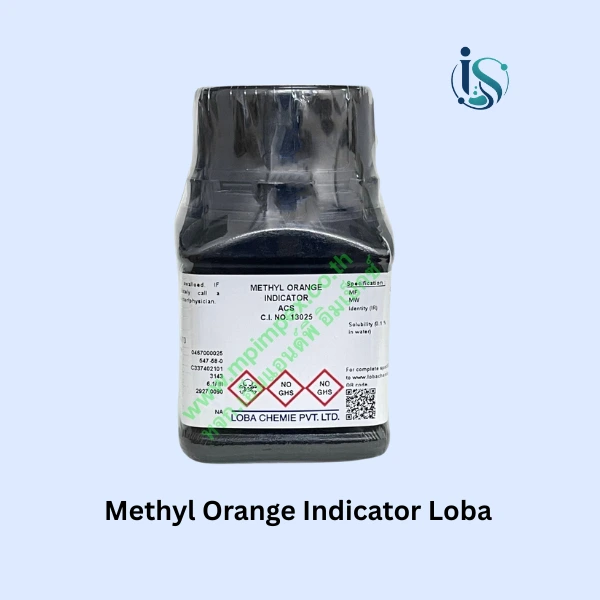
Methyl Orange Indicator from Loba India is an ACS-grade acid-base indicator supplied in a 25gm pack for supervised educational, analytical and institutional laboratory work. The matched product is Loba Article No. 04670, with C.I. No. 13025 and packing code 00025.
Methyl Orange changes colour over an acidic pH range. Loba specifies a visual transition from pink or red at approximately pH 3.2 to yellow-orange at approximately pH 4.4. This makes it useful for approved acid-base titrations and pH demonstrations where the expected endpoint falls within that range.
The manufacturer lists an ACS solubility test for a clear 0.1% aqueous solution and an absorption maximum of 461–469nm in 0.01N sodium hydroxide. A numerical purity percentage is not stated on the current product page, so buyers should evaluate the product using its indicator-grade specification and current batch COA.
Methyl Orange is classified as toxic if swallowed. It should be handled only by trained personnel or students under direct supervision, with suitable eye protection, gloves, dust control, secure storage and hazardous-waste disposal.
Contact Inaya Scientific to confirm current stock, Bangladesh price, article number, batch COA, expiry date and suitability for the intended syllabus, titration method or analytical procedure before ordering.
Key Features
- Loba Chemie Article No. 04670.
- 25gm packing code: 00025.
- ACS indicator grade.
- Colour Index Number: C.I. 13025.
- Chemical formula: C₁₄H₁₄N₃NaO₃S.
- CAS number: 547-58-0.
- Molar mass: 327.33g/mol.
- Yellowish-orange, odourless powder.
- Visual transition range: pH 3.2, pink or red, to pH 4.4, yellow-orange.
- A 0.1% aqueous solution is specified to be clear under the ACS test.
- Absorption maximum: 461–469nm in 0.01N sodium hydroxide.
- Limited water solubility; the manufacturer’s pages describe a low-solubility aqueous solid.
- Suitable for approved acid-base indicator preparation and educational laboratory demonstrations.
- Listed shelf life: 60 months under recommended conditions.
- Classified as toxic if swallowed, Acute Toxicity Category 3.
- Transport classification: UN 3143, Dye, solid, toxic, n.o.s., Class 6.1, Packing Group III.
- Nationwide delivery may be available across Bangladesh, subject to stock and chemical-transport confirmation.
Product Overview
Methyl Orange is a synthetic azo dye used primarily as an acid-base indicator. Its molecular structure changes with acidity, producing a visible colour shift across the approximate pH range of 3.2–4.4.
Below the transition range, the indicator appears pink or red. Above the range, it appears yellow to yellow-orange. The exact observed shade may depend on indicator concentration, lighting, sample colour, temperature, solvent composition and the analytical method.
Because its transition occurs in an acidic range, Methyl Orange is commonly selected for titrations where the equivalence-region pH passes through this interval. It is not a universal choice for every acid-base titration, and the method should specify the correct indicator.
The Loba ACS product is supplied as a solid indicator powder. Laboratories normally prepare a dilute indicator solution according to a recognised method. The correct solvent, concentration, storage bottle and expiry period for the prepared solution should be specified by the laboratory procedure.
Main Applications
Strong-Acid and Weak-Base Titrations
Methyl Orange may be used in approved titrations where the endpoint occurs within its acidic transition range, including selected strong-acid and weak-base systems. Indicator selection must follow the method and should not be based only on the names of the reagents.
Selected Strong-Acid and Strong-Base Titrations
In some standard educational procedures, Methyl Orange can provide a visible endpoint in strong-acid and strong-base titrations because the pH changes sharply near equivalence. The chosen indicator and endpoint interpretation must match the approved practical instructions.
Acidic pH Demonstrations
The indicator may be used in supervised demonstrations showing how indicator colour changes as an acidic solution is adjusted through approximately pH 3.2–4.4. Only small quantities and known, compatible solutions should be used.
Preparation of Methyl Orange Indicator Solution
Trained laboratory personnel may prepare a dilute Methyl Orange indicator solution using a recognised formula. The solution should be labelled with its concentration, solvent, preparation date, hazards, storage conditions and responsible person.
Comparison of Acid-Base Indicators
Schools, colleges and universities may compare Methyl Orange with indicators such as methyl red, phenolphthalein or bromothymol blue to demonstrate that different indicators change colour over different pH ranges.
Endpoint Selection and Titration-Curve Study
Advanced students may compare the Methyl Orange transition range with a calculated or measured titration curve. This helps explain why an indicator can be suitable for one titration but unsuitable for another.
Spectrophotometric Teaching Experiments
University laboratories may use Methyl Orange in selected absorbance or wavelength studies. Loba lists an absorption maximum of 461–469nm in 0.01N sodium hydroxide. Instrument settings and solution preparation must follow the approved protocol.
Research and Quality-Control Laboratory Work
The ACS indicator may be used in validated analytical procedures where its transition range, solubility and absorbance specification are suitable. The current batch COA should be reviewed for critical work.
Key Benefits
Defined indicator transition: Loba specifies a clear visual change across pH 3.2–4.4.
ACS indicator grade: The product includes identity, solution-clarity, transition-range and absorbance specifications.
Strong visual contrast: The red or pink to yellow-orange change can provide a clear endpoint in suitable methods.
Useful for education: It supports lessons on pH, indicator chemistry, titration curves and endpoint selection.
Small laboratory pack: The 25gm pack is practical because indicator solutions normally require only small quantities of solid.
Verified manufacturer details: Loba publishes the article number, formula, packings, transition range, absorption maximum and shelf life.
Who Should Buy This Product?
This product is suitable for properly equipped school chemistry laboratories, college science departments, university chemistry laboratories, polytechnic institutes, teacher-training laboratories, research facilities, quality-control departments and institutional procurement teams that require an ACS-grade Methyl Orange indicator.
It may also suit chemistry teachers, lecturers, trained laboratory technicians, analysts and researchers who need a defined acidic-range indicator for approved titration, pH demonstration or absorbance procedures.
This product is not intended for household colouring, food use, cosmetic use, textile production, medical diagnosis, self-treatment or unsupervised student handling. Methyl Orange indicator powder is toxic if swallowed.
Usage and Handling Summary
Methyl Orange Indicator should be handled only by trained personnel according to the product label, current Loba Safety Data Sheet, institutional chemical-hygiene plan and approved laboratory procedure.
The Loba SDS classifies this product as Acute Toxicity Category 3 by the oral route and states that it is toxic if swallowed. Do not eat, drink or smoke while using the product, and wash hands, forearms and face thoroughly after handling.
Wear safety glasses, protective gloves and a laboratory coat. Minimise dust during weighing and transfer. Use an appropriate mask or local dust control where airborne powder may be generated.
Prepare only the quantity and concentration required by the approved method. Use clean, dry tools and suitable containers. Do not return unused material to the original bottle, because contamination may affect indicator performance.
Prepared indicator solutions should be stored in a suitable labelled container under the conditions stated in the method. Colour, clarity or endpoint response should be checked before use when the solution has been stored for an extended period.
If swallowed, rinse the mouth and immediately call a doctor or poison centre, following the SDS and local emergency procedure. For eye contact, rinse cautiously with water for several minutes and seek medical advice if irritation continues. Wash exposed skin with soap and water.
For a spill, keep unnecessary persons away, avoid creating dust and collect the powder promptly using a scoop or suitable vacuum. Prevent unnecessary release to the environment and place the recovered material in a labelled hazardous-waste container.
Store the product in its original tightly closed container in a dry location. Protect it from moisture, direct sunlight, air exposure, contamination and unauthorised access.
Limitations and Important Considerations
- This content applies to Loba Methyl Orange Indicator ACS, Article No. 04670, 25gm packing code 00025.
- Loba does not state a numerical purity percentage on the current product page; use the ACS indicator-performance specification and batch COA.
- The transition range is approximately pH 3.2–4.4 and is not suitable for every acid-base titration.
- Methyl Orange is generally unsuitable for endpoints that occur mainly in a neutral or alkaline pH range unless a recognised method specifically requires it.
- Sample colour or turbidity may obscure the visual endpoint and make instrumental detection or another method more appropriate.
- Indicator concentration can influence the visible shade and endpoint sharpness; follow the approved preparation formula.
- The solid is toxic if swallowed and must remain inaccessible to unauthorised persons and unsupervised students.
- The product can stain skin, clothing, benches and porous laboratory materials.
- Water-solubility descriptions differ across manufacturer materials; follow the recognised solution-preparation method rather than assuming rapid dissolution.
- The solid product should not be confused with Loba Methyl Orange Indicator Solution, Article No. 04671, which is a separate liquid product with different hazards.
- Transport is regulated as UN 3143, Dye, solid, toxic, n.o.s., Class 6.1, Packing Group III.
- Dispose of the product and contaminated packaging through a licensed hazardous-waste route, subject to local regulations.
- The listed 60-month shelf life applies under the manufacturer’s specified conditions; confirm the actual expiry date on the supplied pack.
- Check the current batch COA when transition performance, absorbance maximum or solution clarity is important to the method.
Contact Inaya Scientific for confirmation of the current batch COA, SDS, label details, transition range, expiry date, article number, stock status and suitability for the intended laboratory application.
Available Pack Sizes or Variations
The confirmed product requested is:
25gm Methyl Orange Indicator ACS – Loba India, Article No. 04670, packing code 00025
Loba also lists 100gm and 1000gm packings for Article No. 04670. Availability may differ by country, distributor and current stock.
Loba separately supplies Methyl Orange Indicator Solution under Article No. 04671. The liquid solution has a different formulation, flash point, hazard classification and packaging, so it should not be treated as the same product.
Methyl Orange Price in Bangladesh
The current Methyl Orange Loba India 25gm price in Bangladesh is available on request. The final price may vary according to article number, batch, import cost, currency movement, stock status, freight, hazardous-goods handling, tax and delivery location.
Contact Inaya Scientific for the latest retail price, institutional quotation or bulk-order rate. Mention Loba Article No. 04670, ACS grade and the 25gm pack when requesting a quotation to avoid confusion with the separate Methyl Orange Indicator Solution.
Availability and Delivery in Bangladesh
Methyl Orange Indicator Loba India 25gm is available from Inaya Scientific subject to current stock confirmation. Nationwide delivery support may be available across Bangladesh.
Because the product is classified as a toxic solid for transport, delivery method, cost and destination coverage may depend on the carrier, quantity, packaging and applicable restrictions. Buyers should provide their organisation name, delivery location, required quantity and intended laboratory application when requesting an order confirmation.
Why Buy From Inaya Scientific?
Inaya Scientific supplies laboratory chemicals, educational laboratory items, instruments, glassware and scientific products to professional and institutional customers in Bangladesh. Buyers can verify important product and safety details before placing an order.
- Current stock and Bangladesh price confirmation.
- Brand, article number, grade and pack-size verification.
- Batch COA and current SDS availability confirmation.
- Indicator transition and intended-application enquiry support.
- Bulk and institutional quotations.
- School, college, university and research laboratory sourcing support.
- Nationwide delivery coordination, subject to chemical-transport requirements.
Frequently Asked Questions
- What is Methyl Orange used for?
Methyl Orange is used as an acid-base indicator in suitable titrations and pH demonstrations. It changes from pink or red in stronger acidic conditions to yellow-orange above its transition range.
- What is the pH transition range of Loba Methyl Orange?
Loba lists a visual transition from approximately pH 3.2, pink or red, to pH 4.4, yellow-orange.
- Can Methyl Orange be used for every acid-base titration?
No. It is suitable only when the expected endpoint passes through its acidic transition range. The approved method or titration curve should be used to select the correct indicator.
- What is the Loba article number and pack code?
The matched product is Loba Methyl Orange Indicator ACS, Article No. 04670. The 25gm packing code is 00025.
- What are the formula, CAS number and molar mass?
The formula is C₁₄H₁₄N₃NaO₃S, the CAS number is 547-58-0 and the molar mass is approximately 327.33g/mol.
- Does Loba state a purity percentage for this product?
The current Loba product page does not show a numerical purity percentage. The product is specified through ACS indicator tests, including identity, solution clarity, transition range and absorption maximum.
- Is Methyl Orange hazardous?
Yes. The Loba SDS classifies it as toxic if swallowed, Acute Toxicity Category 3. It requires controlled handling, secure storage, protective equipment and hazardous-waste disposal.
- How should Methyl Orange be stored?
Keep it in its original tightly closed container in a dry place. Protect it from moisture, direct sunlight, air exposure, contamination and unauthorised access.
- What is the price of Methyl Orange Loba 25gm in Bangladesh?
The current Bangladesh price is available from Inaya Scientific on request. Price may change with stock, import cost, exchange rate, regulated transport, tax and batch availability.
- Can I order Methyl Orange with nationwide delivery?
Yes, subject to stock and chemical-transport confirmation. Provide the required quantity, institution name, delivery location and intended laboratory use when requesting a quotation.
Order From Inaya Scientific
Order Methyl Orange Indicator Loba India 25gm from Inaya Scientific for supervised school, college, university, research and approved professional laboratory applications.
Seller: Inaya Scientific
Mobile: +880 1778-492798
WhatsApp: 01620247815
Email: inayascientific@gmail.com
Website: www.inayascientific.com
Delivery: Nationwide delivery across Bangladesh, subject to chemical-transport requirements
Before ordering, contact Inaya Scientific to confirm the current price, stock, exact brand, article number, grade, pack size, batch documents, expiry date and delivery conditions.




Reviews
There are no reviews yet.