
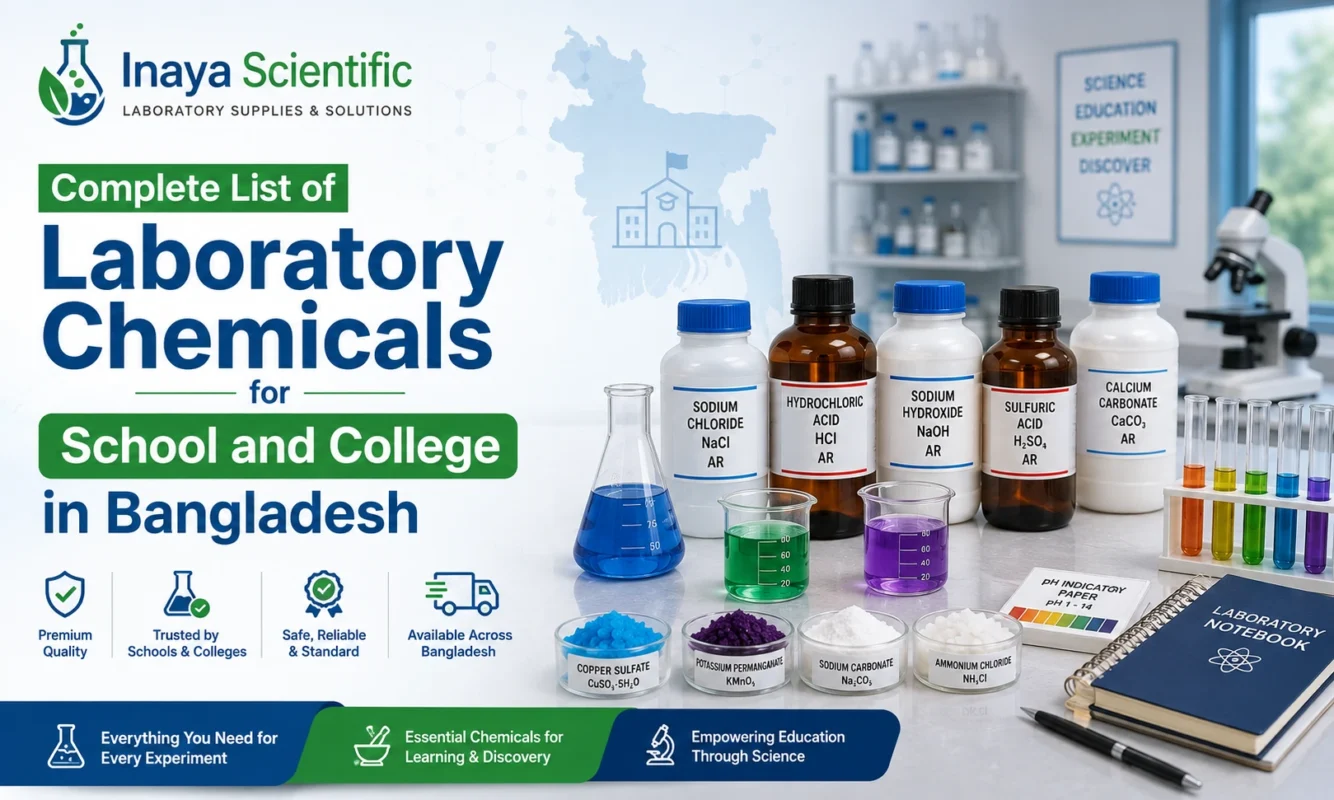
What Chemicals Are Needed in School and College Laboratories?
Schools and colleges in Bangladesh commonly require acids, alkalis, salts, indicators, solvents, oxidizing agents, reducing agents and biological testing reagents for chemistry and general science practical classes.
The exact list depends on the institution’s curriculum, laboratory facilities, student level and approved experiments. Common examples include Hydrochloric Acid, Sulphuric Acid, Sodium Hydroxide, Sodium Carbonate, Copper Sulphate, Potassium Permanganate, Methyl Orange, Universal Indicator, Lugol’s Iodine and Deionized Water.
However, institutions should not purchase every chemical simply because it appears on a general list. Teachers and laboratory personnel should select chemicals according to the approved syllabus, practical requirements, available safety equipment and the current Safety Data Sheet for each product.
Why Is a Proper Laboratory Chemical List Important?
A carefully planned laboratory chemical list helps an institution purchase the correct chemicals in suitable quantities without creating unnecessary safety risks or storing materials that are unlikely to be used.
A proper chemical inventory can help schools and colleges:
- Conduct syllabus-based chemistry practicals
- Avoid unnecessary chemical purchases
- Reduce expired and unidentified stock
- Select the correct chemical grade
- Maintain accurate stock records
- Store incompatible chemicals separately
- Prepare for practical examinations
- Control laboratory expenses
- Improve teacher and student safety
- Manage chemical waste responsibly
NIOSH recommends that school laboratories evaluate the hazards of chemicals and consider whether suitable handling facilities are available before deciding to use them. Its school chemistry safety guidance also emphasizes inventory management, appropriate precautions and the prevention of harmful exposure or injuries.
Complete School and College Laboratory Chemical List
The following list covers chemicals commonly associated with secondary school, higher secondary and introductory college laboratory activities. It is a planning guide rather than a universal mandatory procurement list.
1. Common Laboratory Acids
Hydrochloric Acid
Hydrochloric Acid is widely used in acid-base experiments, neutralization reactions, carbonate testing, pH demonstrations, titration work and selected qualitative-analysis procedures.
Concentrated Hydrochloric Acid is corrosive and releases irritating fumes. It should remain under the control of trained teachers or laboratory personnel and should only be diluted according to an approved procedure.
Sulphuric Acid
Sulphuric Acid may be required for acid-base reactions, preparation of selected solutions, dehydration demonstrations, titration procedures and advanced chemistry practicals.
Concentrated Sulphuric Acid is strongly corrosive and generates considerable heat when mixed with water. Only trained personnel should prepare diluted solutions, following the laboratory’s risk assessment and current SDS.
Nitric Acid
Nitric Acid may be used in selected college-level analytical and inorganic chemistry procedures. It is a strong acid and oxidizing agent and should not be treated as a routine student-access chemical.
Schools should only stock Nitric Acid when it is specifically required, suitable storage and ventilation are available, and trained personnel can control its use.
Acetic Acid
Acetic Acid is used in acidity experiments, buffer preparation, neutralization activities and demonstrations involving weak acids.
Diluted Acetic Acid may be suitable for many educational activities, while Glacial Acetic Acid requires much stricter handling because of its corrosive properties.
Citric Acid
Citric Acid is a comparatively manageable organic acid used in pH experiments, acid-base reactions, buffer-related demonstrations and introductory practical classes.
It can be useful when a less hazardous acid is suitable for the learning objective.
Oxalic Acid
Oxalic Acid may be used in selected titration procedures, standard-solution preparation and quantitative chemistry practicals.
It is harmful if swallowed and requires controlled handling, suitable labeling and appropriate protective equipment.
Boric Acid
Boric Acid may be required for selected buffer systems, qualitative tests and educational demonstrations. Institutions should confirm that its use is necessary for the intended practical before purchasing it.
2. Bases and Alkalis
Sodium Hydroxide
Sodium Hydroxide is one of the most common laboratory alkalis. It is used in neutralization reactions, titration, pH adjustment, soap-related demonstrations and preparation of alkaline solutions.
Sodium Hydroxide pellets readily absorb moisture and carbon dioxide from the air. They should be stored tightly closed, and solution preparation should be performed by trained personnel because dissolving the pellets in water produces heat.
Potassium Hydroxide
Potassium Hydroxide is a strong alkali used in selected titration, analytical, reagent-preparation and organic chemistry procedures.
Like Sodium Hydroxide, it is corrosive and hygroscopic. Schools and colleges should only purchase it when the syllabus or approved method specifically requires it.
Ammonia Solution
Ammonia Solution, also known as Ammonium Hydroxide Solution, is used in alkaline pH demonstrations, qualitative inorganic analysis, complex-formation reactions and preparation of selected ammoniacal reagents.
The solution releases strong ammonia vapor and may cause severe irritation or corrosive injury depending on its concentration. Concentrated Ammonia Solution should be handled in a suitable fume hood or approved well-ventilated working area.
Calcium Hydroxide
Calcium Hydroxide is commonly associated with limewater preparation, carbon dioxide testing, acid-base reactions and demonstrations involving alkaline solutions.
Magnesium Hydroxide
Magnesium Hydroxide may be used in demonstrations of solubility, weakly soluble bases and neutralization reactions.
3. Common Laboratory Salts
Sodium Chloride
Sodium Chloride is used in solution preparation, crystallization, conductivity experiments, solubility studies and introductory chemical-reaction demonstrations.
Sodium Carbonate
Sodium Carbonate is used as an alkaline salt in titration, standard-solution preparation, acid-carbonate reactions and water-related practical work.
Sodium Bicarbonate
Sodium Bicarbonate is useful for acid-carbonate reactions, carbon dioxide generation, buffer demonstrations and basic science experiments.
Sodium Sulphate
Sodium Sulphate may be used in solubility experiments, salt analysis, solution preparation and selected industrial chemistry demonstrations.
Sodium Sulphite
Sodium Sulphite is a reducing agent used in selected redox experiments, dechlorination demonstrations and solution-preparation activities.
Sodium Metabisulphite
Sodium Metabisulphite may be used as a reducing agent and in demonstrations related to sulphur dioxide chemistry. It can release irritating gas when mixed with acids, so its use requires an approved method and adequate ventilation.
Sodium Thiosulphate
Sodium Thiosulphate is widely used in iodometric titration, reaction-rate experiments and selected analytical chemistry practicals.
Ammonium Chloride
Ammonium Chloride is used in qualitative analysis, buffer preparation, ammonium-ion tests and selected demonstrations involving sublimation or thermal decomposition.
Calcium Chloride
Calcium Chloride may be used in drying demonstrations, hydration experiments, solution preparation and reactions involving calcium ions.
The product readily attracts moisture and should be kept in a tightly sealed container.
Magnesium Sulphate
Magnesium Sulphate is used in qualitative ion testing, crystallization, solution preparation and introductory inorganic chemistry experiments.
Copper Sulphate
Copper Sulphate is a familiar blue crystalline salt used in crystallization, electrochemistry, displacement reactions, hydration experiments and qualitative testing.
It should not be released into drains or the environment without an approved waste-management procedure.
Zinc Sulphate
Zinc Sulphate may be used in displacement reactions, electrochemical cells, qualitative analysis and demonstrations involving zinc ions.
Ferrous Sulphate
Ferrous Sulphate is used in iron-ion testing, oxidation-reduction experiments and preparation of selected iron-containing solutions.
It can oxidize during storage, so the condition and suitability of old stock should be checked before use.
Ferric Chloride
Ferric Chloride is used in iron-ion reactions, qualitative analysis, hydrolysis demonstrations and selected analytical procedures.
Potassium Chloride
Potassium Chloride may be used in flame tests, conductivity experiments, solution preparation and reactions involving potassium or chloride ions.
Potassium Iodide
Potassium Iodide is used in iodine chemistry, redox reactions, starch-iodine demonstrations and preparation of selected analytical reagents.
Potassium Permanganate
Potassium Permanganate is a strong oxidizing agent commonly used in redox titration, oxidation demonstrations and qualitative chemistry.
It should be stored away from combustible, organic and reducing materials. The exact concentration and procedure should be determined by the approved experiment.
Potassium Nitrate
Potassium Nitrate may be used in solubility, crystallization, thermal decomposition and selected oxidation demonstrations.
Heating or mixing oxidizing salts with combustible substances should not be performed without a validated educational procedure and direct supervision.
Calcium Carbonate
Calcium Carbonate is used in acid-carbonate reactions, carbon dioxide generation, solubility demonstrations and experiments involving limestone or chalk.
Barium Chloride
Barium Chloride may be used in sulphate-ion testing and selected qualitative-analysis procedures.
Soluble barium compounds can present significant health hazards. Institutions should consider safer alternatives where possible and restrict use to trained personnel or directly supervised advanced students.
Silver Nitrate
Silver Nitrate is used for halide-ion testing, precipitation reactions and selected analytical chemistry procedures.
It can cause burns, stains and environmental harm. Because of its hazards and cost, it should be stored securely and used only in small, method-specific quantities.
4. Laboratory Indicators
Litmus Paper or Litmus Solution
Litmus is used for basic identification of acidic and alkaline solutions. Blue litmus turns red under acidic conditions, while red litmus turns blue under alkaline conditions.
Methyl Orange
Methyl Orange is an acid-base indicator commonly used in selected titrations and pH demonstrations.
The indicator changes color over a specific acidic pH range, so it is not suitable for every titration.
Phenolphthalein
Phenolphthalein is commonly used in acid-base titration. It is colorless in acidic solutions and develops a pink color in sufficiently alkaline conditions.
Universal Indicator Solution
Universal Indicator Solution provides an approximate visual indication across a wide pH range. It is useful for classroom demonstrations, solution comparison and basic pH estimation.
It should not be treated as a replacement for a calibrated pH meter when accurate numerical measurement is required.
pH Paper
pH paper is suitable for rapid approximate pH testing. Different ranges are available, so buyers should select paper appropriate for the expected sample pH.
Starch Solution
Starch Solution is commonly used as an indicator in iodine-related and iodometric reactions. It forms a characteristic dark-colored complex in the presence of iodine.
5. Oxidizing and Reducing Agents
Hydrogen Peroxide
Hydrogen Peroxide is used in oxidation-reduction experiments, catalytic decomposition demonstrations and selected analytical procedures.
Low-concentration solutions are generally more appropriate for basic teaching activities. Concentrated Hydrogen Peroxide, such as 30% solution, presents significantly greater oxidizing and corrosive hazards and should only be handled by trained personnel using suitable controls.
Potassium Permanganate
Potassium Permanganate functions as both an oxidizing reagent and a self-indicating reagent in selected redox titrations.
Sodium Thiosulphate
Sodium Thiosulphate is a common reducing reagent in iodine-based analytical work and reaction-rate experiments.
Sodium Dithionite
Sodium Dithionite is a strong reducing agent used in selected chemical, textile and analytical procedures. It may decompose during unsuitable storage and should not be treated as a routine school chemical unless specifically required.
Iron Powder
Iron Powder may be used in displacement, oxidation and magnetic-property demonstrations. Fine metal powders should be kept away from ignition sources and incompatible oxidizing chemicals.
Zinc Granules
Zinc Granules are used in metal-acid reactions, hydrogen-generation demonstrations, displacement reactions and introductory electrochemistry.
Hydrogen-producing experiments require careful control of ignition sources and suitable ventilation.
6. Organic Solvents and Organic Reagents
Ethanol
Ethanol may be used as a solvent, in evaporation demonstrations, chromatography and selected organic chemistry procedures.
It is flammable and should be stored in an appropriate flammable-liquid storage area, away from heat, flames and oxidizing materials.
Acetone
Acetone is used as a solvent, cleaning reagent and in selected organic chemistry activities.
It is highly flammable and evaporates rapidly. Acetone should only be used in a suitably ventilated area away from sparks, flames and hot surfaces.
Glycerol
Glycerol may be used in viscosity, density, solution and biological slide-preparation activities.
Ethyl Acetate
Ethyl Acetate may be used in introductory organic chemistry, solvent extraction and chromatography. It is flammable and requires suitable storage and ventilation.
Paraffin Wax
Paraffin Wax can be used in melting-point, phase-change and selected physical chemistry demonstrations.
Urea
Urea may be used in solubility, crystallization, nitrogen-compound and selected biochemical demonstrations.
Dextrose or Glucose
Dextrose is used in reducing-sugar tests, fermentation demonstrations, solution preparation and biological chemistry practicals.
7. Biology and Food-Testing Reagents
Lugol’s Iodine Solution
Lugol’s Iodine is commonly used to test for starch and may also be used in selected microscopy and biological applications.
Benedict’s Solution
Benedict’s Solution is used for qualitative testing of reducing sugars. Heating may be required, so the procedure should include suitable heat-resistant glassware and supervision.
Fehling’s Solution A and B
Fehling’s solutions may be used in reducing-sugar tests and introductory analytical chemistry.
The two solutions are generally stored separately and combined according to the approved test method.
Biuret Reagent
Biuret Reagent is used for qualitative testing of proteins. It is alkaline and may contain copper salts, requiring suitable handling and waste control.
Methylene Blue
Methylene Blue is used as a biological stain, redox indicator and in selected microscopy procedures.
Sudan III or Sudan IV
Sudan dyes may be used for qualitative identification of lipids. Institutions should review the exact product’s hazard information before purchase and use.
Iodine Solution
Iodine-based solutions are used in starch testing, redox chemistry and selected biological procedures. Iodine can stain, irritate and produce vapor, so containers should remain tightly closed.
8. Water and Solution-Preparation Materials
Distilled Water
Distilled Water is used for preparing solutions, rinsing glassware and reducing interference from minerals commonly found in tap water.
Deionized Water
Deionized Water is used for reagent preparation, final glassware rinsing and laboratory procedures where dissolved ions may interfere with the result.
ACS laboratory-equipment guidance includes deionized or distilled water in clearly labeled containers among the materials recommended for high school chemistry laboratories.
Buffer Solutions
Standard buffer solutions may be required for pH meter calibration and experiments involving controlled pH. Buyers should select appropriate pH values and confirm expiry, traceability and storage requirements.
Which Chemicals Are Suitable for Schools?
School laboratories should prioritize chemicals that directly support the approved curriculum and can be managed safely with the available facilities.
A practical school-level inventory may include:
- Sodium Chloride
- Sodium Carbonate
- Sodium Bicarbonate
- Calcium Carbonate
- Copper Sulphate
- Magnesium Sulphate
- Ammonium Chloride
- Calcium Chloride
- Diluted Hydrochloric Acid
- Diluted Sulphuric Acid, when required
- Diluted Sodium Hydroxide Solution
- Citric Acid
- Universal Indicator
- Methyl Orange
- Phenolphthalein
- Litmus Paper
- Starch Solution
- Lugol’s Iodine
- Benedict’s Solution
- Low-concentration Hydrogen Peroxide
- Potassium Permanganate in controlled quantities
- Distilled or Deionized Water
Concentrated corrosive chemicals, volatile solvents, strong oxidizing agents and toxic heavy-metal compounds should not be freely accessible to students.
Which Chemicals May Be Needed in College Laboratories?
College laboratories may require a wider selection depending on whether they teach general, inorganic, organic, physical, analytical or biological chemistry.
Additional college-level requirements may include:
- Glacial Acetic Acid
- Potassium Hydroxide
- Concentrated Ammonia Solution
- Oxalic Acid
- Sodium Thiosulphate
- Potassium Iodide
- Ferrous Sulphate
- Ferric Chloride
- Silver Nitrate
- Barium Chloride
- Ethanol
- Acetone
- Ethyl Acetate
- Standard buffer solutions
- Analytical-grade titration reagents
- Specialized indicators
- Chromatography reagents
- Quantitative-analysis standards
These products should only be purchased after confirming the exact method, required grade, concentration, pack size and laboratory safety controls.
How to Choose the Correct Chemical Grade
Not every practical requires the highest or most expensive chemical grade. However, using a chemical with insufficient purity may affect the reliability of analytical results.
Common grade descriptions include:
Laboratory Reagent Grade
Suitable for many routine educational and general laboratory applications, subject to the manufacturer’s specification.
Analytical Reagent Grade
Used when controlled purity and impurity limits are important for quantitative or analytical work.
AR or ACS Grade
These grades may comply with defined analytical specifications. Buyers should check the manufacturer’s current specification rather than relying only on the grade name.
Extra Pure Grade
Often used in general laboratory or production-related applications. The exact purity and impurity profile can vary between manufacturers.
Technical Grade
Usually intended for industrial or non-analytical applications. It may not be suitable for experiments where impurities could alter the result.
Pharmaceutical or Food Grade
These grades are produced for particular regulated applications and should not be assumed to be interchangeable with analytical laboratory reagents.
Before ordering, institutions should confirm:
- Intended experiment
- Required purity
- Assay or concentration
- Chemical formula
- CAS number
- Brand and manufacturer
- Catalogue number
- Pack size
- Storage conditions
- COA availability
- SDS availability
Laboratory Chemical Safety Checklist
Chemical purchasing should always be connected to safe storage, handling, training and waste management.
Maintain an Updated Inventory
Record the chemical name, brand, concentration, grade, quantity, date received, date opened, expiry or retest date, storage location and responsible person.
Keep the Original Label
Do not remove or damage the manufacturer’s label. Secondary containers should also be labeled with the chemical identity, concentration, hazards and preparation date.
Keep Safety Data Sheets Available
ACS advises teachers to consult the SDS for each chemical used in an experiment or demonstration. SDS information supports decisions about handling, storage, protective equipment, disposal and risk assessment.
The standardized SDS format includes information on identification, hazards, composition, first aid, firefighting, accidental release, handling, storage, exposure controls, stability and disposal considerations.
Store Chemicals by Compatibility
Chemicals should not be stored together simply because their names are alphabetically close.
Separate major hazard groups such as:
- Acids
- Bases
- Oxidizing agents
- Flammable liquids
- Water-reactive materials
- Toxic chemicals
- Environmentally hazardous chemicals
The NIOSH Pocket Guide provides chemical-specific information, including important incompatibilities and reactivities.
Use Appropriate Protective Equipment
Depending on the experiment, laboratory personnel may require:
- Chemical splash goggles
- Laboratory coat
- Suitable chemical-resistant gloves
- Closed footwear
- Face protection
- Fume hood or local exhaust ventilation
PPE selection should be based on the product SDS and method-specific risk assessment, not on a single general rule.
Restrict Student Access
Concentrated acids, concentrated alkalis, flammable solvents, toxic chemicals and strong oxidizers should remain under the direct control of trained personnel.
Purchase Small, Practical Quantities
Buying a large container does not always reduce overall cost. Unused chemicals can deteriorate, absorb moisture, become contaminated, lose labels or create long-term disposal problems.
Prepare for Spills and Emergencies
Laboratories should have suitable emergency procedures, trained staff and accessible safety equipment. The correct response depends on the identity, quantity and hazard classification of the spilled material.
Plan Chemical Waste Disposal
Chemical waste should not automatically be poured into sinks or placed in ordinary waste bins. Waste must be identified, separated where required and managed according to institutional procedures and applicable local requirements.
ACS recommends considering hazardous and non-hazardous waste management as part of laboratory safety and sustainability planning.
Laboratory Chemical Buying Checklist in Bangladesh
Before purchasing laboratory chemicals for a school or college, confirm the following information:
- Full chemical name
- Brand or manufacturer
- Required grade
- Required concentration or assay
- CAS number
- Catalogue or product number
- Required pack size
- Country of manufacture, when relevant
- Current stock status
- Manufacturing date
- Expiry or retest date
- Batch Certificate of Analysis
- Current Safety Data Sheet
- Packaging type
- Storage temperature
- Hazardous-chemical transport requirements
- Delivery location
- Required quantity
- Intended laboratory application
- Whether a safer substitute is available
Product labels, warnings and Safety Data Sheets are essential parts of chemical hazard communication. OSHA’s hazard-communication framework emphasizes chemical classification, container labels, SDS availability and worker training. Although individual institutions in Bangladesh must follow applicable local requirements, these principles provide a useful laboratory procurement and safety framework.
Common Laboratory Chemical Purchasing Mistakes
Buying Only by Chemical Name
A single chemical may be available in different grades, concentrations and pack sizes. Ordering only by name can result in receiving the wrong product.
Ignoring Catalogue Numbers
Catalogue numbers help distinguish between products that appear similar but have different grades, concentrations or packaging.
Purchasing Unnecessarily Large Packs
Large packs can increase storage, handling and disposal risks when annual consumption is low.
Buying Without an SDS
Institutions should obtain and review the current SDS before the chemical is introduced into the laboratory.
Treating All Brands as Identical
Products from different manufacturers may have different specifications, impurity limits, packaging and documentation.
Storing Chemicals Alphabetically
Alphabetical storage can accidentally place incompatible substances beside each other.
Allowing Unlabeled Solutions
Every prepared solution should be labeled immediately with its identity, concentration, date, hazards and responsible person.
Keeping Unused or Unidentified Chemicals
Containers with missing labels, uncertain identity, visible deterioration or unknown history should not be used in student experiments.
Why Buy Laboratory Chemicals From Inaya Scientific?
Inaya Scientific supplies laboratory chemicals, glassware, instruments and educational science products for schools, colleges, universities, research laboratories and institutional buyers in Bangladesh.
Customers can contact Inaya Scientific to confirm:
- Brand and manufacturer
- Chemical grade
- Concentration or assay
- Catalogue number
- CAS number
- Pack size
- Current stock
- Bangladesh price
- COA availability
- SDS availability
- Batch and expiry or retest information
- Institutional and bulk quotation
- Nationwide delivery conditions
Availability depends on current stock, sourcing, chemical classification, packaging and transportation requirements.
Frequently Asked Questions
1. What are the most common chemicals used in a school laboratory?
Common school laboratory chemicals include Sodium Chloride, Sodium Carbonate, Sodium Bicarbonate, Copper Sulphate, Calcium Carbonate, Ammonium Chloride, diluted Hydrochloric Acid, diluted Sodium Hydroxide, Potassium Permanganate, Universal Indicator, Methyl Orange, Litmus Paper and Distilled or Deionized Water.
2. Are all chemicals on this list required by every school?
No. The required chemicals depend on the approved syllabus, practical experiments, class level, laboratory facilities and institutional safety policy. Schools should only purchase chemicals that have a clear educational purpose.
3. What chemical grade is suitable for school laboratories?
Laboratory reagent or suitable educational-grade chemicals may be sufficient for many qualitative demonstrations. Analytical practicals may require analytical-grade reagents. The grade should always be selected according to the experiment.
4. What is the difference between laboratory-grade and technical-grade chemicals?
Laboratory-grade products are generally supplied with specifications suitable for laboratory activities. Technical-grade chemicals may contain higher or less-controlled impurities and may not be appropriate for analytical experiments.
5. Do schools need an SDS for every chemical?
An SDS should be obtained and kept accessible for each hazardous laboratory chemical. It provides information about hazards, handling, storage, protective equipment, first aid, accidental release and disposal.
6. How should acids and bases be stored?
Acids and bases should generally be stored in separate compatible storage areas. They should also be separated from chemicals with which they may react dangerously. The exact storage requirement must be confirmed from each product’s SDS.
7. Can laboratory chemicals be stored alphabetically?
Chemicals should first be separated according to compatibility and hazard class. Alphabetical arrangement may then be used within compatible groups where appropriate.
8. How can an institution confirm chemical authenticity?
Buyers should check the sealed manufacturer packaging, label, catalogue number, batch number, COA, SDS, concentration, grade and supplier documentation. Product details should match the purchase order and quotation.
9. What information is needed to request a laboratory chemical quotation?
Provide the chemical name, brand preference, grade, concentration, pack size, quantity, institution name and delivery location. A catalogue number should also be provided when a specific manufacturer product is required.
10. Where can schools and colleges buy laboratory chemicals in Bangladesh?
Schools, colleges, universities and institutional buyers can contact Inaya Scientific for laboratory chemical availability, product verification, price quotations and delivery support across Bangladesh.
Order Laboratory Chemicals From Inaya Scientific
Order laboratory chemicals for school, college, university, research, quality-control and institutional laboratory applications from Inaya Scientific.
Seller: Inaya Scientific
Mobile: +880 1778-492798
WhatsApp: 01620247815
Email: inayascientific@gmail.com
Website: www.inayascientific.com
Delivery: Nationwide delivery support across Bangladesh
Before ordering, confirm the exact chemical name, brand, grade, concentration, catalogue number, pack size, quantity and intended application. Buyers should also request current stock, price, COA, SDS, batch, expiry or retest information and delivery conditions.
Important safety notice: This article is intended as a general procurement and educational planning guide. It is not a substitute for the approved curriculum, current manufacturer label, Safety Data Sheet, institutional risk assessment or supervision by a qualified chemistry teacher or laboratory professional.