
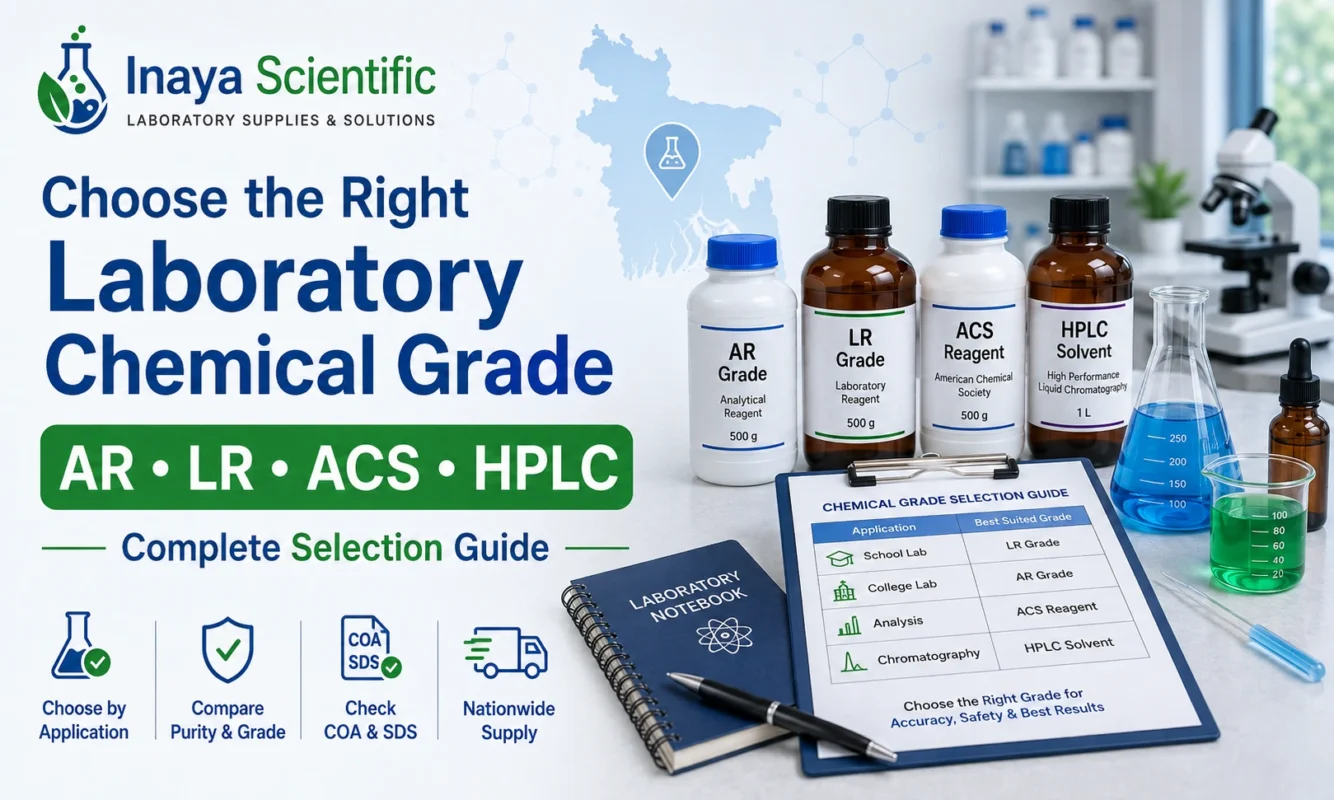
What Is the Right Laboratory Chemical Grade?
The right laboratory chemical grade is the lowest grade that fully meets the purity, impurity, documentation and performance requirements of the intended method.
Routine school demonstrations may use an appropriate laboratory reagent, while quantitative analysis may require AR, ACS-compliant or another specified analytical grade. HPLC, LC-MS, molecular biology and regulated testing require application-specific chemicals that have been tested for relevant contaminants and performance characteristics.
A higher-priced grade is not automatically better for every application. However, using a grade below the method’s requirements may produce unreliable results, introduce contamination or damage sensitive instruments.
Introduction
Laboratory chemicals are sold under terms such as technical grade, laboratory reagent, LR, AR, ACS reagent, HPLC grade, molecular biology grade, EMSURE®, EMPARTA® and EMPLURA®.
These labels help buyers understand a product’s intended use, but they are not always interchangeable. Two chemicals with the same name and similar headline purity may have different impurity limits, documentation, testing parameters and recommended applications.
The American Chemical Society explains that reagent-grade chemicals are sufficiently pure for most general chemical analyses or reactions. However, specialized applications may require chemicals meeting additional or more rigorous specifications.
For this reason, schools, colleges, universities, research facilities and quality-control laboratories in Bangladesh should select chemicals according to the actual method—not only according to price, brand or purity percentage.
Laboratory Chemical Grade Selection Summary
The following comparison gives buyers a practical overview. Exact terminology and specifications may vary between manufacturers, so the current product specification and Certificate of Analysis must always be checked.
|
Chemical Grade |
Common Applications |
General Selection Guidance |
|
Technical grade |
Industrial processing, production and non-analytical work |
Use only when controlled analytical purity is not required |
|
Basic or preparative grade |
Cleaning, preparation and routine production |
Suitable for non-critical laboratory preparation when the specification meets the task |
|
Laboratory reagent or LR |
General teaching, qualitative reactions and routine laboratory work |
Confirm assay and impurity limits before analytical use |
|
Analytical reagent or AR |
Titration, quantitative chemistry and routine analytical testing |
Choose when controlled purity and impurities are important |
|
ACS reagent grade |
General precise analytical work |
Confirm the product meets the applicable ACS monograph |
|
Premium analytical grade |
Critical, regulated or demanding wet-chemical analysis |
Consider when extended specifications and documentation are needed |
|
HPLC grade |
Liquid chromatography mobile phases and sample preparation |
Use only products qualified for HPLC or the specific detector |
|
LC-MS or UHPLC-MS grade |
Mass-spectrometry-based chromatography |
Required where trace contaminants or ionic background may affect sensitivity |
|
Spectrophotometric grade |
UV-visible and optical analysis |
Selected for controlled absorbance and optical interference |
|
Molecular biology grade |
DNA, RNA, protein and cell-related workflows |
Select only when qualified for the intended biological procedure |
|
Reference standard |
Calibration, identification and quantitative standardization |
Use certified or suitable standard materials according to the method |
|
Pharmacopoeial grade |
Testing or production governed by a named pharmacopoeia |
Confirm the exact USP, BP, Ph. Eur. or other stated compliance |
What Does Laboratory Chemical Grade Mean?
A laboratory chemical grade indicates the product’s expected quality level, specification and intended application.
A chemical specification may include:
- Minimum assay
- Maximum moisture
- Insoluble matter
- Residue after evaporation or ignition
- Acidity or alkalinity
- Chloride
- Sulphate
- Phosphate
- Iron
- Heavy metals
- Trace elements
- UV absorbance
- Particulate content
- Chromatographic suitability
- Microbial or biological suitability
ACS explains that chemical specifications generally include an assay of the main constituent and tests for impurities or minor constituents. A chemical’s general physical description should not be confused with its measurable acceptance specification.
Therefore, a label such as “99% pure” does not provide enough information by itself. A method may be affected by a particular impurity even when the overall assay appears high.
Common Laboratory Chemical Grades Explained
Technical Grade
Technical-grade chemicals are commonly produced for industrial processing, manufacturing, cleaning or other applications where highly controlled analytical impurity limits are unnecessary.
They may provide an acceptable concentration of the main chemical while containing larger or less-controlled levels of:
- Moisture
- Metals
- Insoluble matter
- Organic impurities
- Related compounds
- Manufacturing residues
Technical grade may be economical for appropriate production uses, but it should not automatically be used for titration, instrument calibration or quantitative analytical work.
Suitable applications may include:
- Industrial processing
- Non-critical cleaning
- Bulk production
- Preliminary trials
- Applications specifically validated for technical-grade material
Avoid using it when:
- The method specifies AR, ACS or another analytical grade
- Trace impurities can affect the result
- The chemical will be used as a calibration standard
- Regulatory documentation is required
- Sensitive instruments are involved
Laboratory Reagent or LR Grade
Laboratory reagent grade is often used for general laboratory work, teaching, preparation and qualitative experiments.
However, “LR” is not a complete universal specification. The actual suitability depends on the manufacturer’s assay, tested impurities and product documentation.
LR-grade chemicals may be considered for:
- School chemistry demonstrations
- College practical classes
- Qualitative reactions
- Routine solution preparation
- Non-critical washing or cleaning
- Preliminary testing
Before using an LR product for quantitative work, verify:
- Assay
- Relevant impurity limits
- Lot or batch COA
- Intended application
- Method requirements
Analytical Reagent or AR Grade
AR-grade chemicals are intended for analytical work where controlled purity and impurity levels are important.
Depending on the manufacturer, an AR product may include specifications for the main assay and selected impurities that could interfere with common laboratory analyses.
AR-grade chemicals may be suitable for:
- Acid-base titration
- Redox titration
- Gravimetric analysis
- Qualitative analysis
- Quantitative solution preparation
- Routine quality-control testing
- University chemistry experiments
AR grade should not automatically be assumed suitable for HPLC, LC-MS or trace-element analysis. Those methods may require application-specific grades with different performance testing.
ACS Reagent Grade
ACS reagent specifications are prepared for reagents used in precise analytical work of a general nature. The current ACS Reagent Chemicals reference contains purity specifications for almost 500 reagent chemicals and more than 500 standard-grade reference materials.
A product described as ACS reagent grade should conform to the relevant ACS monograph rather than simply using “ACS” as a general marketing term.
Depending on the chemical, an ACS specification may include tests for:
- Assay
- Insoluble matter
- Residue
- Chloride
- Sulphate
- Phosphate
- Heavy metals
- Iron
- Moisture
- UV suitability
- Chemical-specific impurities
ACS reagent grade may be appropriate for:
- General analytical chemistry
- Accurate solution preparation
- Routine quantitative testing
- Method development
- Research work
- Quality-control applications
Some specialized methods may still require a grade that exceeds general ACS specifications.
Understanding Merck EMSURE®, EMPARTA® and EMPLURA®
EMSURE®, EMPARTA® and EMPLURA® are Merck quality ranges rather than universal chemical-grade terms used identically by all manufacturers.
Merck divides selected inorganic reagents and classical solvents into three quality levels based on application, specification and budget.
EMSURE®
EMSURE® is Merck’s premium analytical range for critical, regulated and demanding analytical work.
Most EMSURE® products meet or exceed applicable ACS, ISO and Reag. Ph. Eur. guidelines, depending on the individual product. Merck states that EMSURE® products may include broader specification profiles and more detailed batch information than lower product ranges.
Consider EMSURE® for:
- Critical quantitative analysis
- Regulated laboratory procedures
- Pharmaceutical analysis when the exact product compliance matches the method
- Sensitive wet-chemical testing
- Method development
- Applications requiring extended impurity information
EMSURE® should still be selected by exact catalogue number and product specification.
EMPARTA®
EMPARTA® is Merck’s standard-grade range for routine analytical laboratory work.
Merck describes EMPARTA® products as covering important analytical parameters while offering fewer specified parameters and packaging options than EMSURE®. EMPARTA® products are specified according to ACS requirements where applicable.
Consider EMPARTA® for:
- Routine analytical tests
- Standard laboratory procedures
- General titration
- Routine quality-control work
- Budget-conscious applications requiring ACS compliance
EMPLURA®
EMPLURA® is Merck’s basic-grade range for preparative laboratory work, cleaning and standard production applications.
Merck describes EMPLURA® as a cost-efficient option with specifications covering common parameters and flexible pack-size availability.
Consider EMPLURA® for:
- Preparative laboratory work
- Cleaning applications
- General production
- Non-critical chemical preparation
- Processes not requiring premium analytical purity
Do not use EMPLURA® as an automatic substitute when an analytical method specifies EMSURE®, ACS or another defined grade.
HPLC-Grade Solvents
HPLC-grade solvents are qualified for high-performance liquid chromatography.
A solvent that performs adequately in ordinary solution preparation may contain contaminants that interfere with an HPLC detector, increase baseline noise, produce unwanted peaks or shorten column life.
Commercial HPLC-grade solvents are designed to limit relevant impurities and may be tested for properties such as:
- UV absorbance
- Residue after evaporation
- Water content
- Particulate contamination
- Gradient suitability
- Fluorescence background
- Lot-to-lot consistency
Sigma-Aldrich states that HPLC-grade solvents are highly purified to reduce contamination and interference. Some gradient-grade solvents are filtered and controlled for low UV background to support clearer detection.
Thermo Fisher recommends using at least HPLC-grade solvents and additives for standard HPLC, with higher or application-specific grades for more sensitive techniques.
Use HPLC grade for:
- HPLC mobile phases
- HPLC sample preparation
- Column washing when specified
- HPLC reagent preparation
- LC-UV analysis
Do not assume that AR-grade acetone, methanol or acetonitrile is automatically HPLC-suitable.
LC-MS and UHPLC-MS Grade
LC-MS and UHPLC-MS instruments can be more sensitive to trace contaminants than routine HPLC systems.
Suitable solvents are controlled for factors that may include:
- Ionic background
- Metal contamination
- Mass-spectral noise
- UV response
- Particulates
- Non-volatile residue
- Adduct formation
- Lot consistency
Thermo Fisher describes chromatography and mass-spectrometry solvents as high-purity products qualified for techniques including HPLC, LC-MS, UHPLC-MS, GC and GC-MS.
Choose LC-MS or UHPLC-MS grade when:
- The detector is a mass spectrometer
- Trace-level sensitivity is required
- Background ions can interfere
- The validated method specifies this grade
- Instrument contamination must be minimized
Using a lower-grade solvent may initially appear cheaper but can increase instrument cleaning, troubleshooting and repeat-analysis costs.
Spectrophotometric Grade
Spectrophotometric-grade solvents are designed for optical analysis where solvent absorbance can interfere with the measurement.
The most important factor is not only overall purity, but performance within the wavelength range used by the method.
Consider spectrophotometric grade for:
- UV-visible spectrophotometry
- Optical blank preparation
- Wavelength-sensitive analysis
- Photometric assay preparation
- Applications requiring low absorbance background
Check the product’s absorbance specification and wavelength range before purchase.
Molecular Biology Grade
Molecular biology-grade chemicals are qualified for specific biological workflows.
Depending on the product, relevant testing may address substances that interfere with:
- DNA
- RNA
- Enzymes
- Proteins
- Cell culture
- Nucleic-acid extraction
- Amplification
- Electrophoresis
For example, a molecular biology-grade isopropanol product may be specifically designated for nucleic-acid precipitation and DNA or RNA workflows.
Select molecular biology grade for:
- DNA extraction
- RNA extraction
- Nucleic-acid precipitation
- Molecular assay preparation
- Protein workflows
- Validated biological procedures
A chemical with a high assay is not automatically free from nucleases or other biologically relevant contaminants.
Reference Standards and Standard-Grade Materials
Reference standards are not ordinary reagent chemicals.
They are used for activities such as:
- Instrument calibration
- Quantitative standard preparation
- Analyte identification
- Method performance checking
- Quality control
- Traceability
ACS distinguishes reagent-grade chemicals from standard-grade reference materials used for calibration, identification and other high-purity analytical applications.
When a validated method requires a certified reference material, an ordinary AR or ACS reagent should not be substituted without technical approval.
Chemical Grade Versus Purity Percentage
Chemical grade and purity percentage are related, but they are not the same.
Consider two Sodium Chloride products that both state an assay of at least 99%.
One may be tested for:
- Calcium
- Magnesium
- Iron
- Potassium
- Heavy metals
- Sulphate
- Phosphate
The other may provide only the main assay.
Both labels may show 99%, yet they may perform differently in an analytical method affected by calcium or trace metals.
The correct comparison should include:
- Chemical identity
- Chemical form
- Assay
- Relevant impurity limits
- Test methods
- Grade
- Application suitability
- Documentation
- Pack size
- Catalogue number
Choosing Chemical Grade for School Laboratories
School laboratories should choose chemicals that support the approved curriculum without creating unnecessary cost or risk.
Suitable choices may include laboratory reagent or educationally appropriate grades for:
- Acid-base demonstrations
- Indicator experiments
- Solubility studies
- Crystallization
- Basic qualitative reactions
- Introductory redox experiments
- General solution preparation
Analytical or ACS grades may be justified when:
- Students perform quantitative titrations
- Accurate standard solutions are required
- The syllabus specifies analytical quality
- Impurities would affect the learning outcome
Schools should not automatically buy technical grade simply because it is cheaper. They should also avoid purchasing premium analytical grades when the additional specification provides no educational benefit.
Choosing Chemical Grade for College Laboratories
College laboratories frequently require a combination of general and analytical grades.
Laboratory reagent grade may support:
- Routine demonstrations
- General preparation
- Qualitative tests
- Cleaning
- Preliminary experiments
AR or ACS-compliant products may support:
- Volumetric analysis
- Standard-solution preparation
- Gravimetric analysis
- Quantitative practicals
- Inorganic analysis
- Routine instrumental preparation
The chemistry teacher or laboratory head should create a grade requirement for each experiment rather than applying one grade to the entire chemical inventory.
Choosing Chemical Grade for University and Research Laboratories
University and research requirements depend on the method and instrument.
A research laboratory may require:
- AR or ACS reagents for wet chemistry
- HPLC-grade solvents for chromatography
- LC-MS-grade solvents for mass spectrometry
- Molecular biology-grade chemicals for nucleic-acid workflows
- Spectrophotometric grade for optical analysis
- Trace-metal-grade acids for elemental analysis
- Certified standards for calibration
Researchers should review:
- Published method
- Standard operating procedure
- Instrument manufacturer recommendations
- Target detection limit
- Potential interfering impurities
- Required traceability
- Laboratory accreditation requirements
The most expensive grade is not always necessary, but changing a validated grade may require method verification.
Choosing Chemical Grade for Quality-Control Laboratories
Quality-control laboratories should follow the approved method, product specification and applicable regulatory requirements.
Before approving a reagent, confirm:
- Exact chemical name
- Grade
- Catalogue number
- Assay
- Required impurity limits
- Pharmacopoeial or standards compliance
- COA
- SDS
- Lot or batch number
- Expiry or retest date
- Storage requirements
- Change-control requirements
Merck states that product specifications, Certificates of Analysis and safety documentation are available across its EMSURE®, EMPARTA® and EMPLURA® ranges, although the documentation depth differs by product range.
Application Examples
Sodium Chloride
For a simple school solubility demonstration, a suitable laboratory reagent may be adequate.
For precise analytical work, select a product with controlled assay and impurity limits relevant to the method.
For calibration or trace analysis, a certified or application-specific material may be required.
Acetone
Technical or basic-grade Acetone may be suitable for certain cleaning and production tasks.
ACS or analytical grade may be needed for general analytical use.
HPLC-grade Acetone should be selected when the product is used in chromatography and the method allows it.
The same chemical name does not make the grades interchangeable.
Deionized Water
General deionized water may be appropriate for glassware rinsing and routine reagent preparation.
ACS Reagent Chemicals includes specifications for reagent water covering factors such as conductivity, ions, UV suitability and chromatography suitability.
HPLC or LC-MS workflows may require specially qualified water to control particles, ionic contaminants and detector background.
Hydrochloric Acid
A basic or preparative grade may be suitable for non-critical preparation or cleaning where validated.
AR or ACS-compliant Hydrochloric Acid may be selected for routine quantitative wet chemistry.
Trace-metal analysis may require a specially purified acid with much lower metal contamination.
The nominal concentration alone does not determine suitability.
Documents to Check Before Purchasing
Product Specification
The specification shows the parameters the manufacturer controls for that product.
Check whether it includes the impurities relevant to your application.
Certificate of Analysis
The COA generally provides batch-specific results or confirmation against the specification.
Check:
- Product number
- Batch number
- Assay
- Test parameters
- Release status
- Expiry or retest information
Safety Data Sheet
The SDS provides information about:
- Hazards
- First aid
- Fire response
- Spills
- Handling
- Storage
- Exposure control
- Stability
- Incompatibility
- Disposal
- Transport
An SDS does not prove analytical purity. It is a safety document, while the COA and specification support product quality verification.
Product Label
The bottle label should match:
- Product name
- Brand
- Grade
- Concentration
- Catalogue number
- Pack size
- Batch
- Hazard information
- Storage requirements
How to Choose the Right Grade Step by Step
Step 1: Define the Application
Decide whether the chemical is needed for:
- Teaching
- Qualitative analysis
- Quantitative analysis
- Cleaning
- Production
- HPLC
- LC-MS
- Spectrophotometry
- Molecular biology
- Calibration
- Regulated testing
Step 2: Check the Method
Review the approved syllabus, SOP, standard method or research protocol.
Use the grade specified by the method unless a qualified person approves an alternative.
Step 3: Identify Critical Impurities
Determine which impurities may affect:
- Reaction
- Titration endpoint
- Detector response
- Blank value
- Recovery
- Instrument performance
- Stability
- Biological activity
Step 4: Compare Product Specifications
Do not compare only the product title or percentage purity.
Compare the full manufacturer specification.
Step 5: Review COA and SDS Availability
Confirm that the current batch documentation can be supplied when required.
Step 6: Confirm Pack Size
Choose a pack that can be used within the product’s practical storage and retest period.
Step 7: Compare Total Cost
Include:
- Product price
- Shipping
- Hazardous transport
- Storage
- Waste
- Repeat analysis
- Instrument maintenance
- Unused expired stock
Step 8: Record the Approved Product
Institutional buyers should record the approved brand, catalogue number, grade and pack size to reduce ordering mistakes.
Common Chemical-Grade Selection Mistakes
Choosing by Price Alone
A cheaper chemical may not meet the method’s impurity requirements.
Choosing by Purity Percentage Alone
Two products with the same assay can have different impurity profiles.
Assuming AR and ACS Are Always Identical
An AR product may follow a manufacturer’s specification, while ACS reagent grade refers to conformance with an applicable ACS monograph.
Using HPLC Grade for LC-MS Without Verification
HPLC-grade solvent may not provide sufficiently low ionic or mass-spectral background for LC-MS.
Using Technical Grade in Quantitative Analysis
Uncontrolled impurities may affect blanks, endpoints, recoveries or reproducibility.
Buying Premium Grade for Every Application
This can increase costs without improving results in routine, non-critical work.
Ignoring Hydration State
Anhydrous, monohydrate and dihydrate products have different formula weights and solution-preparation calculations.
Ignoring Catalogue Numbers
The same brand may offer several grades of the same chemical under different product numbers.
Laboratory Chemical Grade Buying Checklist
Before placing an order, confirm:
- Full chemical name
- CAS number
- Formula and hydration state
- Required grade
- Assay or concentration
- Critical impurity limits
- Intended application
- Brand
- Catalogue number
- Pack size
- Packaging material
- Current stock
- Batch COA availability
- Current SDS availability
- Expiry or retest date
- Storage temperature
- Country of manufacture, when required
- Transport restrictions
- Delivery location
- Institutional quotation requirements
Does Higher Grade Always Mean Better?
A higher grade can offer broader specifications, lower impurity limits or stronger documentation. However, it is only better when those advantages matter to the application.
For example:
- Premium analytical Sodium Chloride may offer no meaningful benefit for a basic classroom crystallization demonstration.
- General laboratory Methanol may be unsuitable for HPLC because detector-related contaminants matter.
- HPLC-grade water may still be unsuitable for a sensitive LC-MS method if the method requires LC-MS-grade water.
- Technical Sodium Hydroxide may work for some production tasks but be inappropriate for accurate analytical titration.
The correct principle is:
Do not pay for specifications you do not need, but never purchase below the method’s requirements.
Laboratory Chemical Grade and Price in Bangladesh
The price of a laboratory chemical in Bangladesh depends on:
- Chemical identity
- Grade
- Brand
- Purity
- Concentration
- Pack size
- Origin
- Stock
- Import cost
- Documentation
- Packaging
- Hazardous transport
Technical or basic-grade products may cost less than analytical or instrument-grade products.
However, price comparisons are only meaningful when the following are identical:
- Chemical form
- Grade
- Concentration
- Pack size
- Brand or equivalent specification
- Documentation
- Application suitability
Contact Inaya Scientific with the exact product and grade requirement to receive a current quotation.
Key Takeaways for Selecting Laboratory Chemical Grade
- Select chemical grade according to the method and application.
- A high purity percentage does not reveal the complete impurity profile.
- LR and AR terminology may depend on the manufacturer’s specification.
- ACS reagent grade should conform to the relevant ACS monograph.
- HPLC, LC-MS and molecular biology applications require application-qualified products.
- Technical grade should not be used for precise analysis unless the method permits it.
- EMSURE®, EMPARTA® and EMPLURA® are Merck product-quality ranges.
- Review the specification, COA, SDS, catalogue number and product label.
- Schools should balance educational requirements, safety and cost.
- Research and QC laboratories should follow approved methods and documentation requirements.
Why Buy Laboratory Chemicals From Inaya Scientific?
Inaya Scientific supplies laboratory chemicals, reagents, glassware, instruments and educational laboratory products for buyers in Bangladesh.
Schools, colleges, universities, research facilities, quality-control laboratories and institutional customers can contact Inaya Scientific for:
- Chemical-grade confirmation
- Brand and catalogue-number verification
- Assay and concentration confirmation
- Product specification enquiry
- COA availability
- SDS availability
- Pack-size selection
- Current Bangladesh price
- Stock confirmation
- Institutional quotation
- Bulk-order support
- Nationwide delivery coordination
Availability depends on the exact brand, grade, pack size, stock and transport requirements.
Frequently Asked Questions
1. What is the best laboratory chemical grade?
There is no single best grade for every application. The best grade is the one that meets the method’s purity, impurity, documentation and performance requirements without unnecessary additional cost.
2. What is AR-grade chemical?
AR generally means analytical reagent grade. It is intended for analytical work where controlled purity and impurity levels are important. Buyers should check the manufacturer’s complete specification because AR criteria may vary.
3. What is LR-grade chemical?
LR usually refers to laboratory reagent grade for general laboratory, educational or routine work. It may not meet the requirements of precise quantitative or instrumental analysis.
4. Is ACS grade better than AR grade?
The terms cannot be compared only by name. ACS reagent grade indicates conformance with the relevant ACS monograph, while AR may follow a manufacturer’s analytical specification. Compare the actual parameters and method requirements.
5. Can AR-grade solvent be used for HPLC?
Not automatically. HPLC-grade solvents are qualified for chromatographic performance, including relevant detector background and contaminants. Use a solvent explicitly specified for HPLC when required.
6. What chemical grade is suitable for school laboratories?
Suitable laboratory reagent grades may support many school demonstrations. Quantitative experiments may require AR, ACS-compliant or another specified grade. The teacher should select the grade according to the syllabus and experiment.
7. What chemical grade is suitable for university research?
The required grade depends on the research method. A laboratory may need AR, ACS, HPLC, LC-MS, molecular biology, spectrophotometric, trace-analysis or certified reference materials.
8. Does 99.9% purity mean HPLC grade?
No. The assay does not confirm UV background, particles, residue, water, ionic contamination or chromatographic suitability. The product must be qualified for the intended technique.
9. Why are higher-grade chemicals more expensive?
Higher-grade chemicals may require additional purification, more specification tests, lower impurity limits, controlled packaging and more detailed quality documentation.
10. Where can I buy different laboratory chemical grades in Bangladesh?
Schools, colleges, universities, research laboratories and institutional buyers can contact Inaya Scientific to confirm available brands, grades, pack sizes, documentation, price and nationwide delivery conditions.
Order the Right Laboratory Chemical Grade From Inaya Scientific
Contact Inaya Scientific for laboratory chemicals suitable for educational, analytical, research, quality-control and institutional applications.
Seller: Inaya Scientific
Mobile: +880 1778-492798
WhatsApp: 01620247815
Email: inayascientific@gmail.com
Website: www.inayascientific.com
Delivery: Nationwide delivery support across Bangladesh
When requesting a quotation, provide:
- Chemical name
- Preferred brand
- Required grade
- Concentration or assay
- Catalogue number, when available
- Pack size
- Quantity
- Intended use
- Delivery location
- Documentation requirements
Before ordering, confirm the exact product specification, brand, grade, catalogue number, pack size, batch COA, SDS, expiry or retest information, stock status and delivery conditions.
Important notice: This article is a general laboratory procurement guide. Final chemical-grade selection should follow the approved syllabus, analytical method, SOP, instrument requirement, applicable standard and technical review by a qualified laboratory professional.